_edited.jpg)
Mastering Tort Law for CLAT Legal Reasoning
- Nov 8, 2025
- 5 min read
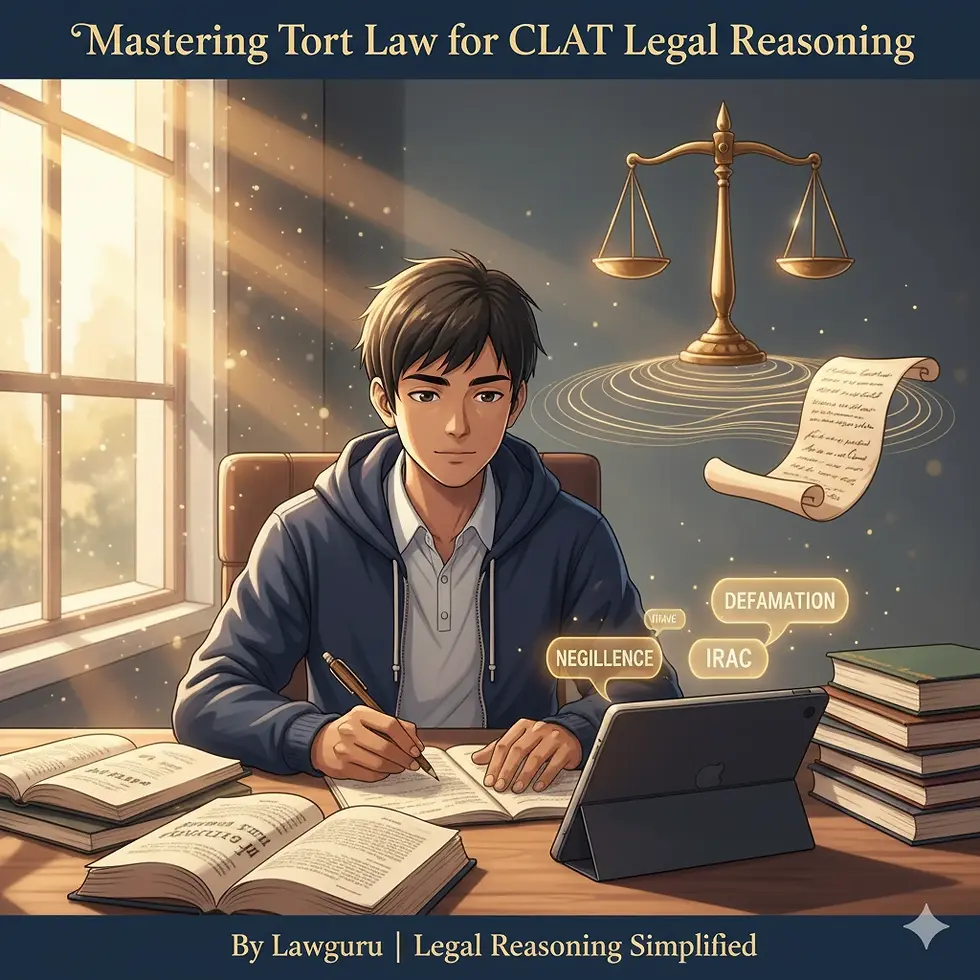
To master CLAT Legal Reasoning, you must think like a problem-solver, not a memorizer. Among all the legal concepts tested, Tort Law stands out — it blends human ethics, social logic, and law in everyday scenarios. Whether it’s negligence, defamation, or nuisance, every situation demands clear reasoning and sharp judgment.
In this guide, we’ll simplify everything about tort law — from foundational principles to case applications — and teach you how to answer passage-based questions with lawyer-like precision.
1. What Is Tort Law and Why Does It Matter for CLAT
Tort Law deals with civil wrongs — acts that cause harm, not necessarily crimes. Its core purpose is to ensure that people act responsibly and compensate others when they don’t.
In the CLAT exam, tort-related questions often appear in the Legal Reasoning section because they test your ability to apply principles to factual situations. Instead of remembering sections, you’ll need to analyze who’s liable and why.
Think of it this way:
Tort law is where morality meets logic — and CLAT checks whether you can connect the two.
2. Core Principles of Tort Law
The entire subject revolves around duty, breach, and damage.
When someone’s carelessness (or deliberate act) harms another, the law steps in. Here’s the simple chain:
Duty → Breach → Causation → Damage
To master these, remember the IRAC method — Issue, Rule, Application, Conclusion. This will be your reasoning compass throughout your CLAT preparation.
3. Negligence — The Foundation of Modern Tort Law
Negligence occurs when someone fails to act with reasonable care. It’s not about intent — it’s about foreseeable risk.
Example: A shopkeeper leaves a puddle of water near the counter. A customer slips, falls, and fractures a leg.
Issue: Was there a duty of care?
Rule: Every owner must keep premises reasonably safe.
Application: The puddle caused foreseeable harm.
Conclusion: The Shopkeeper is liable for negligence.
Key Elements to Remember:
Duty of Care: The obligation to act cautiously.
Breach of Duty: Ignoring that obligation.
Causation: A direct link between act and injury.
Damage: Actual loss or harm caused.
A strong understanding of negligence helps you handle at least 30–40% of tort-based CLAT passages.
4. Defamation — When Words Cause Damage
Defamation balances free speech and reputation protection. A defamatory statement damages a person’s standing in society through false or careless publication.
Two types:
Libel: Written or printed defamation (e.g., a newspaper article).
Slander: Spoken defamation (e.g., an interview).
Mini-case: If a magazine falsely accuses a politician of fraud, and the story damages their career, that’s libel. However, if the allegations were true or made with honest belief, it might not be defamation.
To tackle these passages, always analyze:
Was the statement false?
Was it published or communicated?
Was harm caused to the reputation?
In mock tests, you’ll often encounter passage-based questions on defamation, where distinguishing “criticism” from “defamation” becomes the trickiest part.
5. Nuisance — Disturbing the Peace of Others
Nuisance is about protecting your right to peaceful enjoyment of life and property.
Two forms:
Private Nuisance: Affects an individual or specific group.
Example: Constant construction noise near a house.
Public Nuisance: Affects society at large.
Example: Factory waste polluting a public river.
Tip for CLAT aspirants: When you get a passage describing repetitive or unreasonable interference, don’t jump to conclusions. Ask:
“Is it a personal disturbance (private) or one affecting the public (public)?”
Such distinctions often form subtle traps in the Legal Reasoning section.

6. Real-Life Case Insights — How Courts Interpreted Tort Law
Knowing landmark cases isn’t mandatory for CLAT, but understanding how judges think improves your reasoning quality.
1. Donoghue v. Stevenson (1932): The famous “snail in the bottle” case. Mrs. Donoghue found a decomposed snail in her ginger beer. The court held the manufacturer liable, establishing the duty of care principle.
2. Ashby v. White (1703): A voter was wrongfully denied his right to vote. Even though no monetary loss occurred, the court upheld that the violation of a right itself is actionable.
3. Ushaben v. Bhagyalaxmi Chitra Mandir (1978): Plaintiffs sought to ban a movie for portraying Hindu gods humorously. The court held it wasn’t nuisance or defamation, marking the boundary between personal offense and legal harm.
Why these matter: They show that intent, harm, and public interest must coexist logically for tort liability.
7. Applying the IRAC Method in Tort-Based Questions
For any CLAT Legal Reasoning question, use the IRAC structure:
Step | What It Means | Example |
Issue | Identify the central legal question. | Did the driver act negligently? |
Rule | Recall or infer the legal rule. | A driver owes a duty of care to pedestrians. |
Application | Apply the rule to the facts. | The driver ignored traffic signals. |
Conclusion | State the legal outcome. | The driver is liable for negligence. |
Pro Tip: During the Common Law Admission Test, time is limited. Don’t write IRAC answers formally — think in that framework while reading each passage.
8. Visual Flowchart — “How Tort Law Works”
(Infographic placement suggested here)
Tort Law → Identify Type of Wrong
     ↓
Negligence → Duty → Breach → Causation → Damage
     ↓
Defamation → False Statement → Publication → Harm
     ↓
Nuisance → Unreasonable Interference → Loss
     ↓
IRAC → Reasoning + Application + Decision
This visual acts as your revision shortcut — condensing 10 pages of text into a memory map.
9. Weekly Study Plan for Mastery
Week | Focus | Activities |
1 | Foundation | Read basic tort principles, watch 2 explainer videos. |
2 | Application | Solve 10 passage-based tort questions. |
3 | Integration | Mix tort law with contracts & criminal law. |
4 | Revision | Recreate IRAC summaries & flowcharts. |
Such structured revision keeps your preparation steady and ensures balance between speed and accuracy.
10. How Tort Logic Trains You for Law School Thinking
Tort reasoning isn’t just for CLAT — it mirrors how real lawyers and judges think. When you analyze a passage, you’re essentially developing case-analysis habits you’ll use throughout law school.
This reasoning ability also sharpens your performance in reading comprehension and current affairs, as you learn to detect assumptions, intent, and causation.
By the time you enter law school, you’ll already have the analytical habits of a trained thinker — a major advantage over rote learners.
11. Common Mistakes Students Make
Mixing motive and intention — The motive doesn’t matter; liability does.
Ignoring causation — You must prove a direct connection between the act and the damage.
Forgetting the Application step in IRAC — It’s where most points are scored.
Over-relying on memory — CLAT doesn’t test law sections; it tests logic.
Pro tip: Revisit your wrong answers from previous mocks. Identifying why you went wrong is more valuable than more practice.
12. Advanced Revision Hacks
Create micro flashcards: Front: “Defamation → Truth defense?”Back: “Yes, truth is a valid defense.”
Case chain mapping: Draw a mini web connecting all tort cases you’ve studied.
Use audio recall: Record short summaries in your voice — this improves conceptual memory.
Mock re-analysis: Instead of taking new mocks, re-analyze your past CLAT legal sections for pattern recognition.
13. The Final Four Weeks - Smart, Not Hard
The final month before CLAT isn’t about new learning; it’s about consolidation.
Week 1: Revisit negligence and causation.
Week 2: Focus on defamation and nuisance reasoning.
Week 3: Attempt full-length mocks.
Week 4: Focus on calm recall - concept clarity beats panic reading.
During this period, structured mentoring through online CLAT coaching can fine-tune your reasoning - it gives you real-time feedback on where your logic falters and how to strengthen it.
14. Final Takeaway - Think Like a Lawyer, Not a Student
Mastering tort law for CLAT is less about memorizing maxims and more about thinking through consequences. Every question tests whether you can balance rights and duties like a future legal professional.
Your approach should always be:
Understand the principle.
Analyze the facts.
Apply reasoning with IRAC clarity.
Arrive at a logical conclusion.
By doing this repeatedly, you’ll not only score high in CLAT 2027 but also build a foundation that makes law school lectures intuitive. Tort Law is the bridge between logic and justice — master it, and you’ll never fear the Legal Reasoning section again.


Comments