_edited.jpg)
Mastering Logical Passages for CLAT 2026
- Nov 18, 2025
- 5 min read

Logical reasoning passages have become one of the most crucial scoring areas in modern CLAT papers. Unlike older patterns that tested factual reasoning, the recent papers focus on comprehension-based analytical thinking. Students must read multi-paragraph passages, interpret arguments, analyze author viewpoints, identify assumptions, evaluate logical relationships, and answer questions that test depth of thinking instead of surface-level recall.
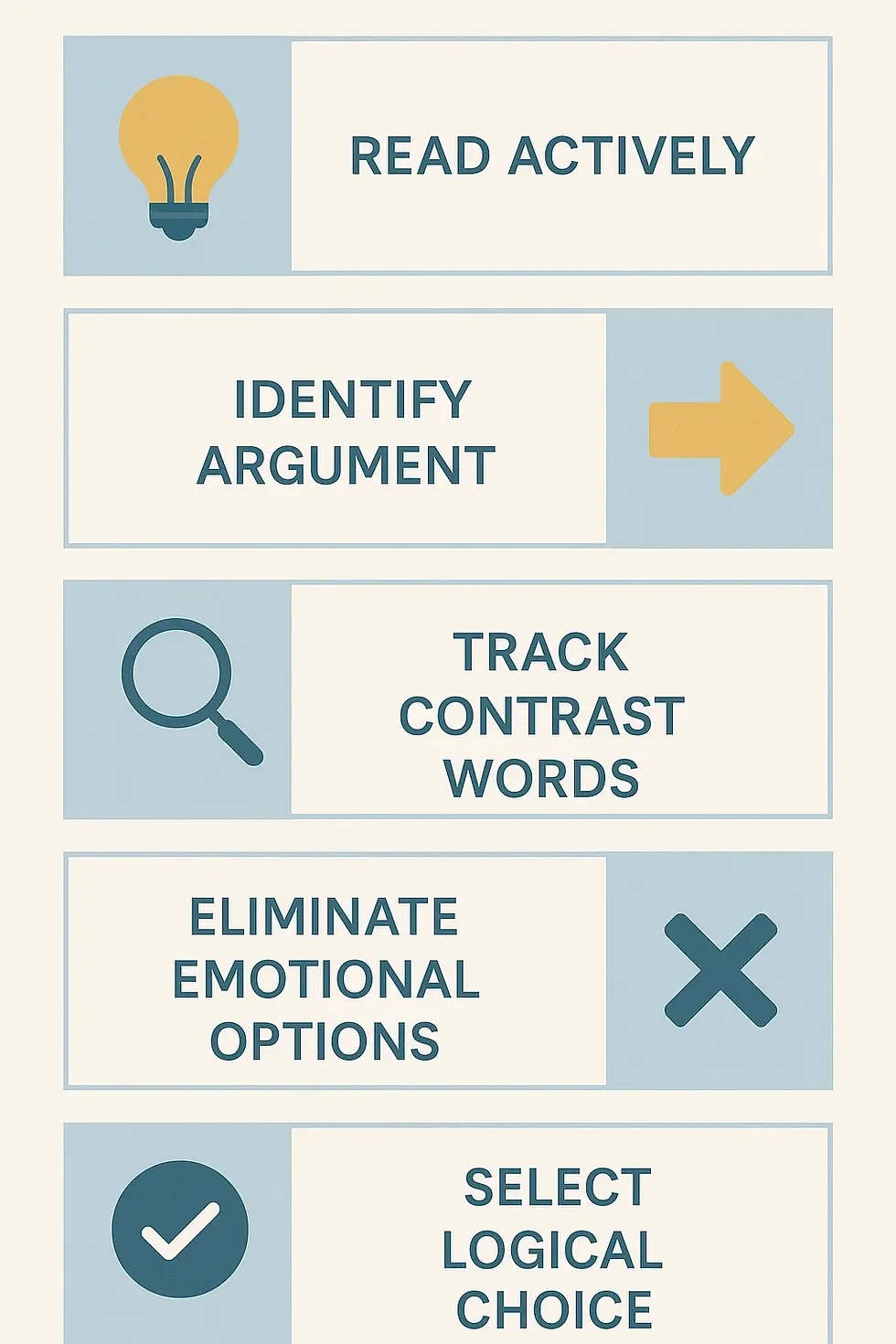
To perform well, aspirants must learn how to read actively, break passages into meaningful segments, and build structured reasoning while avoiding emotional interpretations. This guide explains the most effective strategies to master logical reasoning passages in CLAT with clarity and confidence, even if passages currently feel confusing. If you apply these methods consistently, your understanding, speed, and accuracy will improve steadily.
Let us begin.
Understanding the Structure of Logical Passages
Every passage in logical reasoning follows a simple internal structure. Once you learn to recognise this structure, comprehension becomes easier. Most passages contain four standard components:
Statement of issue
Supporting reasons
Counter views or contrasting arguments
Final position or conclusion
When you identify these layers, you understand what the author is trying to say and where the reasoning is going. Instead of trying to absorb every detail, you begin to read strategically. With practice, students learn to predict the direction of the argument.
This also helps when tracking realistic growth during preparation through tools and reflections similar to the CLAT rank predictor, which many aspirants explore to understand how reasoning performance shapes outcomes.
How to Approach Reading Passages with Strategy
Strong reading habits improve reasoning instantly. The effective way to read a logic-based passage is not to read every word with equal importance, but to recognise structural signals such as therefore, however, but, in contrast, on the other hand, clearly, and finally. These markers indicate movement and shifts in the argument.
Students often realise the difference that reading placement and thinking structure make only after reviewing their growth over time, and this becomes clear, especially in periods when performance analysis reports similar to CLAT 2026 result bring attention to accuracy and time management as the real differentiators.
The focus should always remain on the relationship, claim, and reasoning rather than memorising facts.
Evolving Trends in Logical Reasoning Passages
Question patterns have changed significantly in recent years. Instead of short questions with single-line facts, passages are now longer and denser, testing reasoning depth. A large part of scoring depends on how effectively a student identifies underlying logic and eliminates answers based on emotional appeal or unsupported assumptions.
Trends show that accuracy matters far more than the number of attempts. Even one or two mistakes can change rank movement drastically. Data observations similar to CLAT Marks vs Rank discussions show clearly that performance in logical reasoning strongly influences final position because of high weightage and close competition.
Understanding structure and question intent is the real key.
Common Mistakes Students Make While Solving Logical Passages
The most frequent mistakes include:
Reading too fast and missing qualifiers
Trying to solve before understanding the question
Jumping to conclusions based on emotional response
Not distinguishing between the author’s view and the external perspective
Selecting options that are factually true but logically weak
Students often change their mindset and start treating preparation with greater focus when real deadlines get closer. Many aspirants say that receiving official notices like the CLAT 2026 admit card strengthens seriousness and discipline. This mirrors the idea that clarity and control matter both in reasoning and in preparation strategy.
The best habit is to slow down, anchor thinking, and question every assumption.
Examples of Logical Passage Analysis
Let us examine an example in a simplified format:
Passage idea: Public transportation should be prioritized over developing more private vehicle infrastructure because traffic pollution and congestion harm overall economic productivity.
Possible question: Which argument strengthens the author’s reasoning
Option A: Most citizens prefer using private vehicles for convenience
Option B: Cities that expand public transport networks have recorded faster average commute speeds
Option C: Car showrooms benefit financially when more individuals buy vehicles
Correct answer: Option B, because it supports the premise with relevant real-world impact.
Exercises like this help train clarity and remove confusion. Analytical decision-making improves through practice, just like how aspirants prepare for important planning stages similar to CLAT 2026 counselling, where calm thinking and structured choices determine outcomes.
How to Practice Logical Passages Effectively
The best method to improve performance is through structured practice routines. For every passage solved, write three things:
What was the central argument
What evidence supported the argument
What trap choices appeared in the options
Practice becomes powerful only when reflection accompanies solving. Reviewing explanations similar to checking conceptual clarity through resources such as the CLAT 2026 answer key helps students recognise patterns and correct recurring mistakes. Do not rush. Focus on depth learning.
Improving Performance with Mock Strategy
Mocks develop the stamina required to solve long, high-focus passages under time pressure. Without practice, even skilled students make errors due to fatigue or rushed thinking. The objective is not solving fast but solving accurately through a controlled pace.
A reliable method is:
Warm up with short analytical reasoning
Solve two logical passages back to back
Review solutions thoroughly
Record mistakes and patterns
Repeat with improvements
The brain learns gradually. Reasoning performance accelerates when reflection becomes part of training. Track consistency through weekly review. Steady improvement leads to strong performance in the actual paper.
Practice Questions with Reasoning
Practice Passage One
Statement: Educational reforms must focus on improving teaching quality instead of expanding infrastructure. Buildings do not educate students. Skilled teachers do.
Question: Which argument weakens the author’s conclusion
A: Schools with better infrastructure attract more students
B: Teaching methods affect learning outcomes significantly
C: Poor infrastructure reduces student attendance due to discomfort
D: Research shows student performance improves most when teachers are well-trained
Correct answer: Option C, because it challenges the idea that infrastructure is less relevant.
Practice Passage Two
Statement: Social media regulations are essential to prevent misinformation from influencing public decision-making.
Question: Which statement is an assumption
A: People believe the content they see online
B: Some users share posts without reading
C: Social media companies earn revenue through advertising
D: Internet usage increases every year
Correct answer: Option A
Reason: If people do not believe what they read, misinformation does not spread.
Final Thoughts
Logical reasoning passages require calm thinking, structured reading, and clear interpretation. Do not rush. Identify the argument, locate evidence, understand contrast points, and analyse answer options logically. When you trust reasoning instead of instinct, confidence grows naturally. Every passage solved with understanding builds long-term skill that supports not only CLAT performance but future legal education.
Believe in your progress. Improvement always comes from consistent training.



Comments