_edited.jpg)
International Affairs and Treaties Likely in CLAT
- Dec 8, 2025
- 3 min read

Introduction
International affairs form a critical part of CLAT Current Affairs and are increasingly being tested through analytical passages rather than direct factual questions. The exam expects aspirants to understand how international developments impact India, global governance, and legal frameworks.
From global conflicts to climate summits, trade treaties to human rights conventions, this area connects law, diplomacy, and global politics. A well-planned approach helps you score accurately without memorising endless facts. Understanding ideas, institutions, and implications is the real key.
This guide breaks down the most important international affairs topics and treaties that are most likely to appear in CLAT, with a clear focus on application and relevance. A strong grip here also improves contextual reading and strengthens international current affairs CLAT preparation overall.
Why International Affairs Matters in CLAT
CLAT uses international topics to test three things
Awareness of global events
Ability to understand international law concepts
Analytical reading and inference skills
Questions are often framed through passages discussing treaties, conflicts, geopolitical shifts, or international organisations. When the CLAT 2026 results are announced, aspirants who treated international affairs conceptually rather than as rote facts will see a clear advantage.
How CLAT Tests International Affairs
International affairs usually appear in:-
Current affairs passages
Legal reasoning passages with global context
Inference-based questions
Cause and impact analysis
You are rarely asked for dates or headquarters alone. You are expected to understand
Why did the event happen
What treaty governs it
How India is involved
Why it matters globally
Key International Affairs Topics Likely in CLAT
Global Conflicts and Geopolitical Tensions
Focus on:-
Russia-Ukraine conflict
Israel Palestine issue
South China Sea dispute
Taiwan-China tensions
Understand the background, international reactions and legal implications under international law.
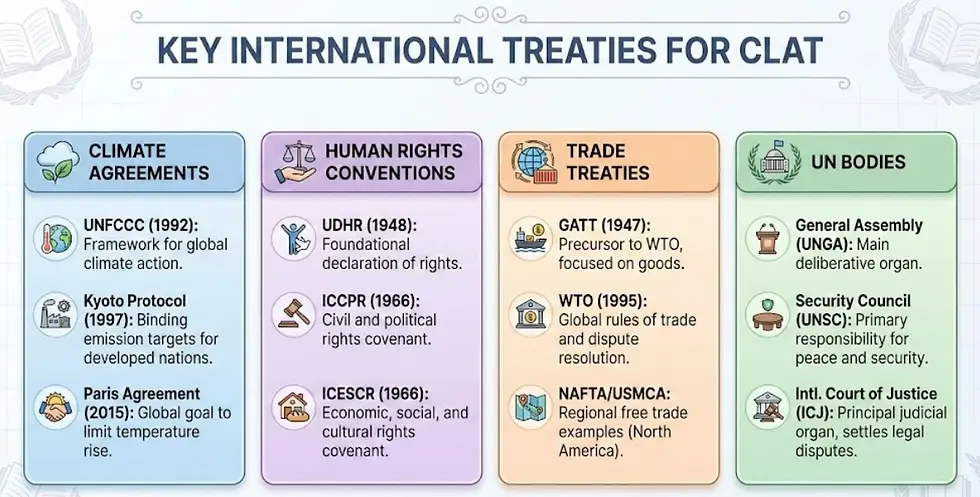
United Nations and Its Bodies
High importance areas:-
UN Security Council
UN General Assembly
UN Human Rights Council
International Court of Justice
Know their roles, powers, recent resolutions, and India’s position.
Major International Treaties and Conventions
Treaties are frequently used as a passage context.
Important treaties to focus on:-
Paris Climate Agreement
Nuclear Non-Proliferation Treaty
Convention on Biological Diversity
UNCLOS
Refugee Convention
Understand objectives, obligations, and current debates.
Climate Change and Environmental Agreements
This area has consistently high weightage.
Key focus areas:-
Climate summits such as COP meetings
Carbon neutrality goals
Loss and damage fund
India’s climate commitments
Environmental treaties often appear linked with legal reasoning passages.
International Trade and Economic Agreements
Important topics:-
WTO disputes
Free trade agreements
International tariffs
Trade sanctions
Economic diplomacy questions test reasoning through practical consequences.
Human Rights and International Law
Essential concepts:-
Universal Declaration of Human Rights
International Covenants
Role of international courts
Humanitarian law
Human rights treaties regularly appear in current affairs passages.
India’s Role in Global Groupings
Know India’s participation in
G20
BRICS
QUAD
SCO
Understand purpose, relevance, and recent outcomes.
Global Health and Science Cooperation
Focus areas
World Health Organization
Pandemic response frameworks
Vaccine diplomacy
International research collaborations
These topics gained importance after global health crises.
How to Prepare for International Affairs Smartly
Read Editorials With a Legal Lens
Focus on why an event matters legally or diplomatically
Who benefits
Who decides
What treaty applies
This mindset improves retention.
Link Treaties with Current Events
Never study a treaty in isolation.
Always ask:-
Where was this treaty mentioned recently
Why is it in the news
What problem does it address
This makes revision efficient.
Make One-Page Treaty Notes
For each treaty note
Purpose
Members
Legal impact
Recent relevance
Short notes help with quick revision.
Practice Passage-Based Questions
CLAT tests comprehension through long passages. Solve international affairs passages regularly and analyze mistakes.
After the CLAT 2026 answer key is released, revisiting such passages helps understand how the international context drives answer logic.
Common Mistakes Aspirants Make
Memorising facts without understanding context
Ignoring India’s role in global issues
Not connecting treaties with current events
Skipping revision
Overloading notes
Avoiding these mistakes greatly improves accuracy.
International Affairs and Rank Stability
International affairs often become the deciding factor when scores are tightly grouped. Analysis of the CLAT 2026 cut-off trends shows that strong performance in current affairs can substantially push rankings higher.
Consistency and clarity are more important than quantity.
Exam Focus Strategy
Before the exam:-
Revise the top treaties and conflicts
Go through the monthly current affairs
Practice passage-based questions
During revision:-
Focus on concepts and implications
Avoid cramming last-minute facts
When reviewing the CLAT 2026 question paper after the exam, you will notice that most international affairs questions stemmed from major globally relevant themes rather than obscure news.
Conclusion
International affairs preparation is about understanding the world through a legal and diplomatic lens. CLAT rewards aspirants who connect global events with treaties, institutions and consequences. With focused reading, structured note making, and regular revision, this section becomes predictable and scoring. Build clarity, stay updated, and practice analytical reading. International affairs can easily become one of your strongest areas if approached strategically.



Comments