_edited.jpg)
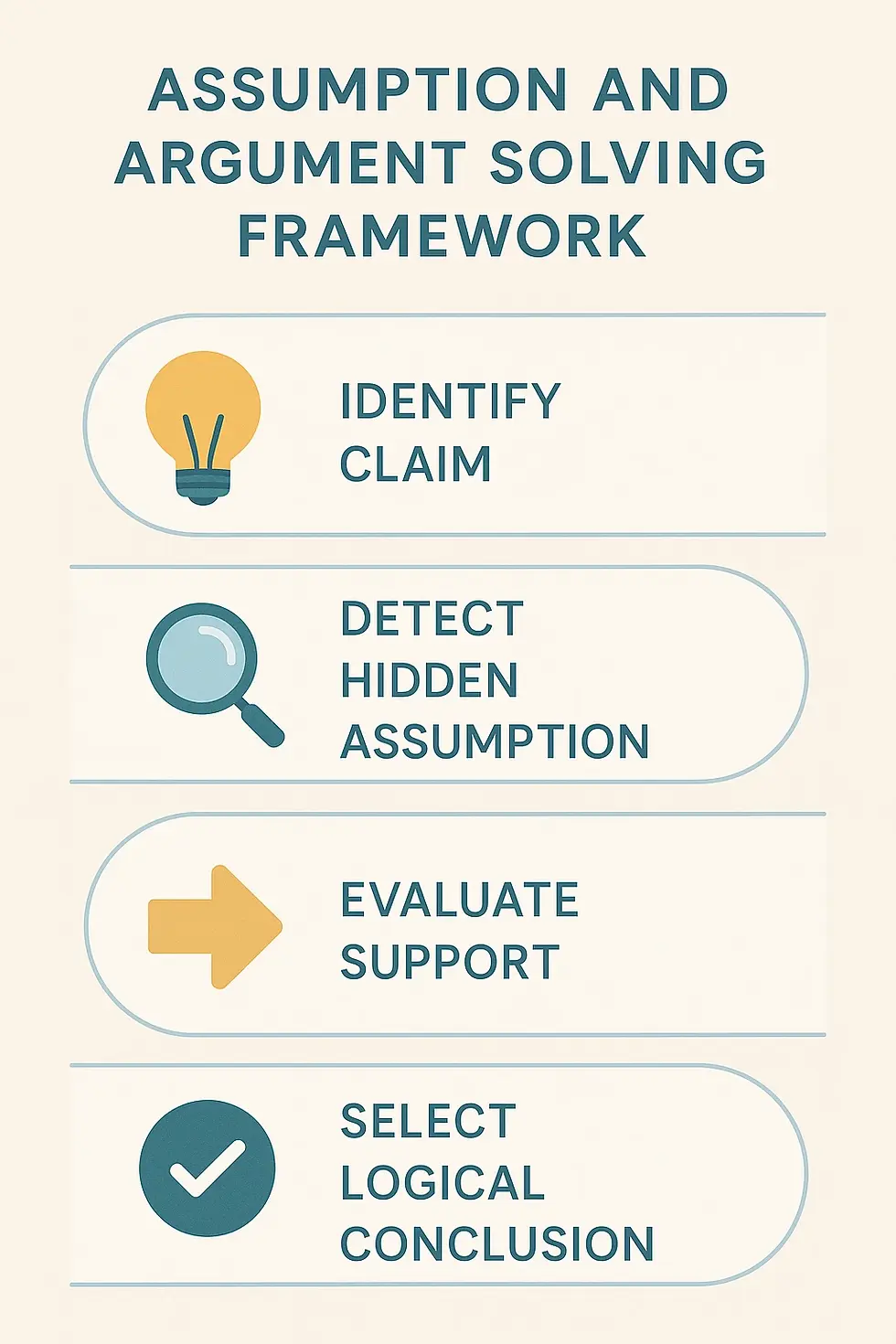
How to Solve Assumption and Argument Questions for CLAT
- Nov 18, 2025
- 4 min read

Assumption and Argument questions are one of the most important parts of Logical Reasoning because they test a student’s ability to understand the hidden meaning behind statements rather than just reading the surface-level text. Many aspirants struggle because these questions look subjective, but they are not subjective at all when approached with method and clarity. Once you understand how assumptions work and how arguments are evaluated, these questions become highly scoring and enjoyable.
This guide will help you learn how to identify assumptions accurately, evaluate arguments logically, and build a structured approach suitable for solving assumption questions in CLAT with confidence. You will also find practice problems with reasoning so you can apply the concepts immediately.
Understanding What an Assumption Really Means
An assumption is an idea that is not directly stated in a sentence but must be true for the statement to make sense. It acts like the foundation of the argument. If the assumption collapses, the argument collapses. Understanding assumptions becomes easier when students analyse thought patterns rather than only reading statements.
For example:
Statement: Air pollution in big cities can be reduced by increasing public transportation facilities.
Possible assumption: People will use public transport if it is easily available.
Without this assumption, the argument does not work. The effectiveness of reasoning depends on identifying what the author is relying on silently.
Students often realise during performance review periods, such as the analysis after receiving the CLAT 2026 result, that logical clarity and structured reasoning matter more than memorisation. Assumption-based questions reflect this concept perfectly.
The Trick to Identifying Hidden Assumptions
The easiest way to find the assumption is to ask one simple question:
What must be true for the statement to hold meaning
If the argument falls apart when the assumption is removed, then it is the right assumption. Strong assumptions support the author’s argument. Weak assumptions break it.
Here is a classic example:
Statement: Online learning improves the academic performance of students.
Assumption: Students have access to digital devices and internet connectivity.
Ask yourself: Would the statement remain valid if the assumption were false? Obviously not.
Many aspirants understand correctness better when verifying answers during comparisons, similar to checking solutions using the CLAT 2026 answer key analysis process. Reasoning questions always highlight whether thinking was clear or rushed.
How to Evaluate Arguments Effectively
In argument questions, you must judge whether an argument strengthens or weakens the conclusion. A strong argument is logical, relevant, and directly connected to the claim. A weak argument is emotional, unrelated, or based on assumptions not supported.
Sample problem:
Statement: Schools should include financial literacy as a compulsory subject.
Argument A: Financial knowledge helps students make better decisions in the future.
Argument B: Many parents never studied finance in school.
Argument A is strong because it logically supports the conclusion.
Argument B is weak because it is irrelevant to the issue.
Just like decision-making in real-life events, such as organised academic counselling support phases that take place around CLAT 2026 counselling, students must choose arguments based on clarity and relevance rather than emotion or bias.
Common Mistakes Students Make in Assumption and Argument Questions
The most repeated errors include:
Reading from personal opinion instead of logic
Choosing answers that feel emotionally correct
Overthinking possibilities instead of certainty
Assuming information that the passage never stated
Trying to solve too fast without structure
Many aspirants feel a shift in seriousness and mental discipline when official preparation phases begin, such as receiving the CLAT 2026 admit card. It reminds students that accuracy and clear thinking matter more than shortcuts.
To avoid mistakes:
Always ask what is necessary for the argument
Remove extra assumptions from your interpretation
Pick the option that supports the conclusion logically
Practice Strategy for Improving Reasoning Accuracy
Practice strengthens logical thinking. The best method is solving ten to fifteen questions daily and analysing the explanation for each answer. Never skip review. The goal is not solving quickly, but understanding patterns deeply. Growth in reasoning comes through reflection.
Tracking performance improvement helps build confidence. Students often realise the value of disciplined reasoning after comparing their performance data through breakdowns similar to CLAT Marks vs Rank analysis. Even a small increase in accuracy changes the ranking dramatically because every logical reasoning question matters.
Maintain a log of errors and rewrite correct reasoning for each one. The improvement becomes measurable within two or three weeks.
The Right Exam Mindset for Logical Reasoning
Reasoning questions demand calm thinking, not fast reading. Think slow to answer fast. Read carefully, analyse, and then decide. Students who panic lose marks not because questions are tough but because they try to jump to answers without adequate thought.
Situational analysis tools such as CLAT rank predictor help students build a realistic understanding of progress. However, real improvement always comes from consistent practice and a stable mental attitude. Training the mind to focus and reason clearly can change outcomes dramatically.
Confidence increases when consistency becomes routine. Focus on improvement, not comparison. Every step matters.
Real Practice Questions with Complete Reasoning
Practice Question One
Statement: Banning single-use plastic will significantly reduce environmental pollution.
Assumption: Alternative materials will be available for daily use.
Reasoning: If substitutes do not exist, the ban does not solve the problem. Therefore, the assumption is necessary.
Correct Answer: Assumption is implicit.
Practice Question Two
Statement: Libraries should extend working hours.
Argument A: Many students who work part-time cannot access libraries during the current timings.
Argument B: Libraries should have more motivational posters.
Reasoning: Argument A is directly connected to supporting the conclusion. Argument B is irrelevant.
Correct Answer: Only Argument A is strong.
Practice Question Three
Statement: Road safety campaigns reduce accidents.
Assumption: Drivers listen to safety instructions and apply them while driving.
Reasoning: If campaigns do not influence behaviour, accidents do not reduce.
Correct Answer: Assumption is implicit.
Final Thoughts
Assumption and argument questions are practical, logical, and high scoring when solved methodically. The key is eliminating emotional thinking and focusing only on logical support. Clarity grows with consistent practice. Once reasoning becomes structured, the section becomes simple and enjoyable.
Train your brain to think like a problem solver. You will notice the difference not only in reasoning scores but in academic confidence. Logical reasoning rewards calm thinking and disciplined effort.
Keep improving. Progress belongs to those who practise consistently.



Comments